Here’s what most checklists get wrong: an Indian wedding doesn’t run on a tidy “twelve months before, nine months before” countdown. It runs on the date — and the date comes from the pandit, not your calendar. Everything else keys off that one fixed point. So instead of arbitrary monthly buckets, here’s how a big Indian wedding actually comes together.
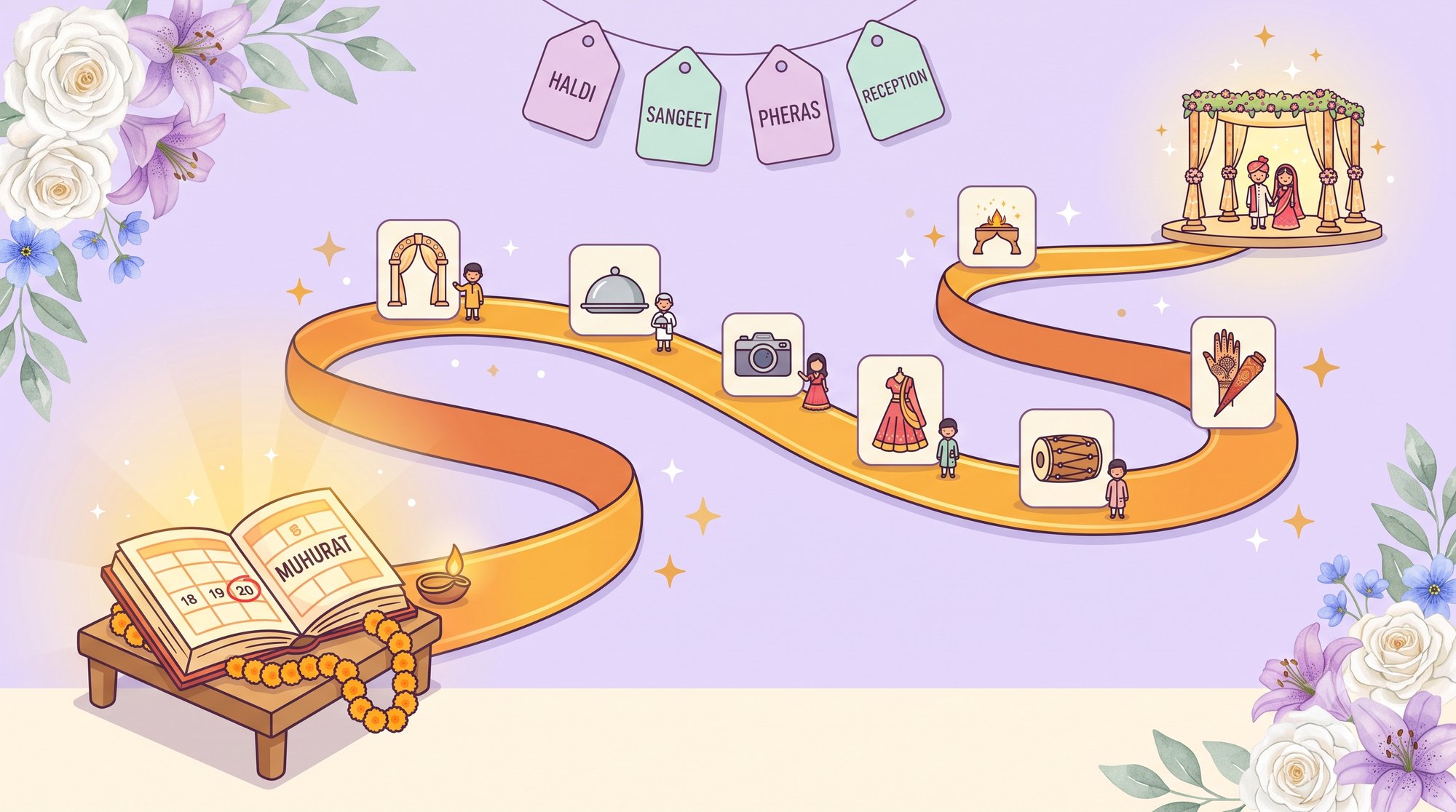
It starts with the date — the muhurat
Before a single venue is called, most families sit with a pandit who reads the couple’s horoscopes and the panchang to fix one or more auspicious dates (muhurat). That date is the anchor for everything that follows — and it’s largely out of your hands, which is exactly why a generic countdown doesn’t fit. Some couples get a date eighteen months away; others are handed one just three or four months out and have to move fast.
One thing stays consistent: the popular muhurat dates cluster in peak season — roughly November through February — and the most sought-after dates (an Akshaya Tritiya, say) are the busiest of all. The deeper your date sits into that window, the earlier everything else has to happen.
The moment the date is set: grab what sells out
As soon as you have a date, three things should be booked almost the same week — they’re the most in-demand and they go first:
- The venue(s). For peak-season and destination weddings, the best properties book 12–18 months ahead. If your date is sooner, this is a today problem, not a someday one.
- The caterer. Often the single biggest line item in an Indian wedding — and the good ones fill up fast.
- The pandit. The priest conducting your ceremony has a calendar full of the very same auspicious dates.
Next: the long-lead vendors
Right behind the venue come the vendors whose calendars — and craft — take time. Don’t wait for some “months-out” cue; book them as soon as the big three are locked:
- Photographer & videographer — the best are reserved as early as the venue itself.
- Decorator — mandap, stage, and florals for each function.
- Outfits — a custom bridal lehenga can take four to eight months, so start early.
- Entertainment — DJ, dhol, live music, and a choreographer for the Sangeet.
- Hair & makeup and the mehndi artist.
Build the guest world
Indian guest lists are a project of their own — often 300 to 500+ people, and rarely the same list for every function. The sooner this lives in one place, the calmer everything downstream becomes:
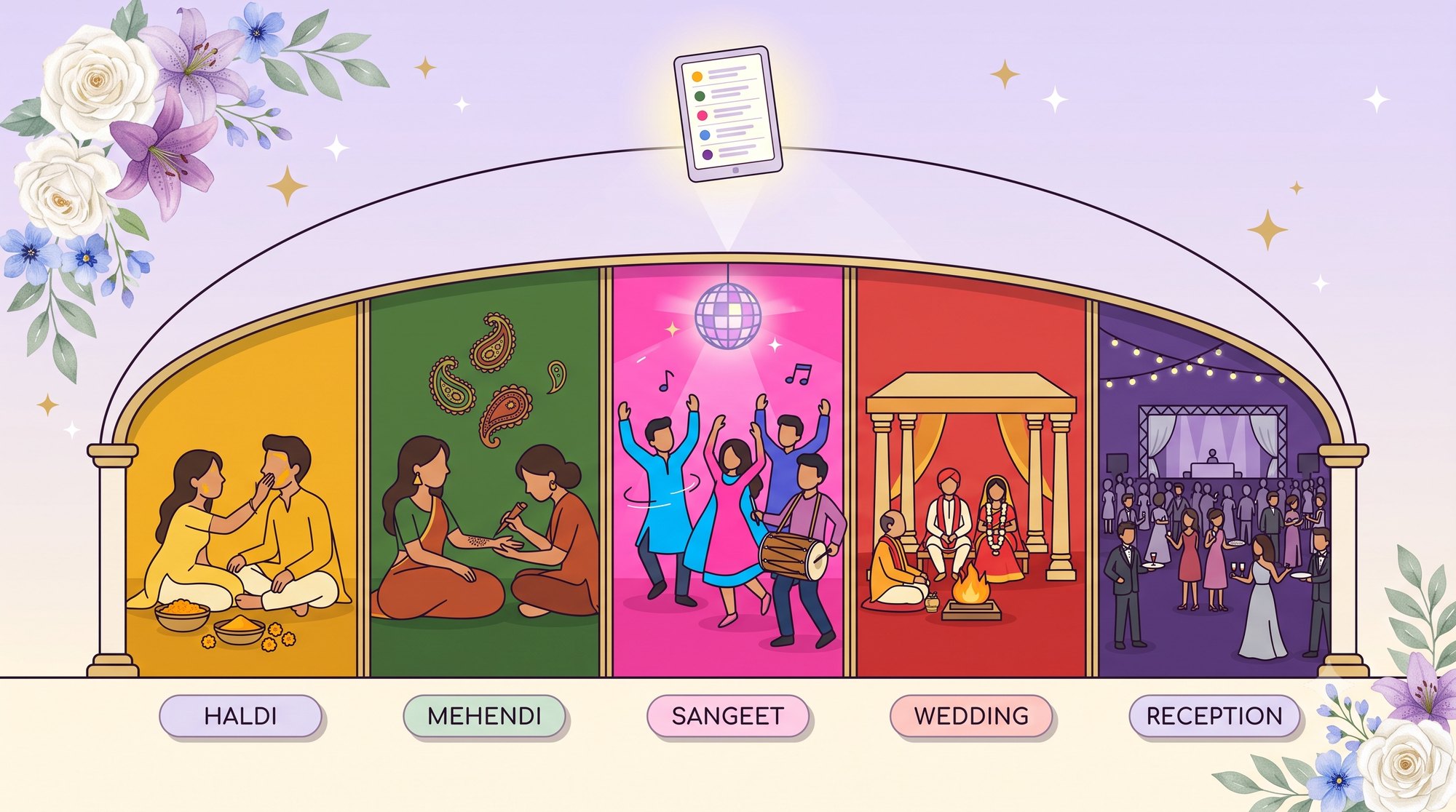
- Start a single master list, tagged by event (Haldi, Sangeet, wedding, reception).
- Send save-the-dates early to outstation and NRI family — they need lead time for flights and visas.
- Sort out hotel room blocks and guest travel.
- Design and order invitations, and decide how you’ll collect RSVPs.
One workspace, every function, always current
eventsplanning.ai keeps each event’s schedule, guest list, and to-dos in a single place you and your planner share — so whether your date is eighteen months out or three, nothing slips through the cracks.
Start Planning FreeGive each function its own plan
A wedding is really five or six celebrations — Roka, Haldi, Mehndi, Sangeet, the wedding pheras, the reception — and each deserves its own look, menu, guest list, and run-of-show. This is the long middle of planning: tastings, decor sign-offs, choreography, and drafting the order of events for every function.
The final stretch
In the last few weeks, planning shifts from deciding to confirming:
- Reconfirm every vendor in writing — timings, deliverables, and points of contact.
- Finalize headcounts per function and share them with the caterer.
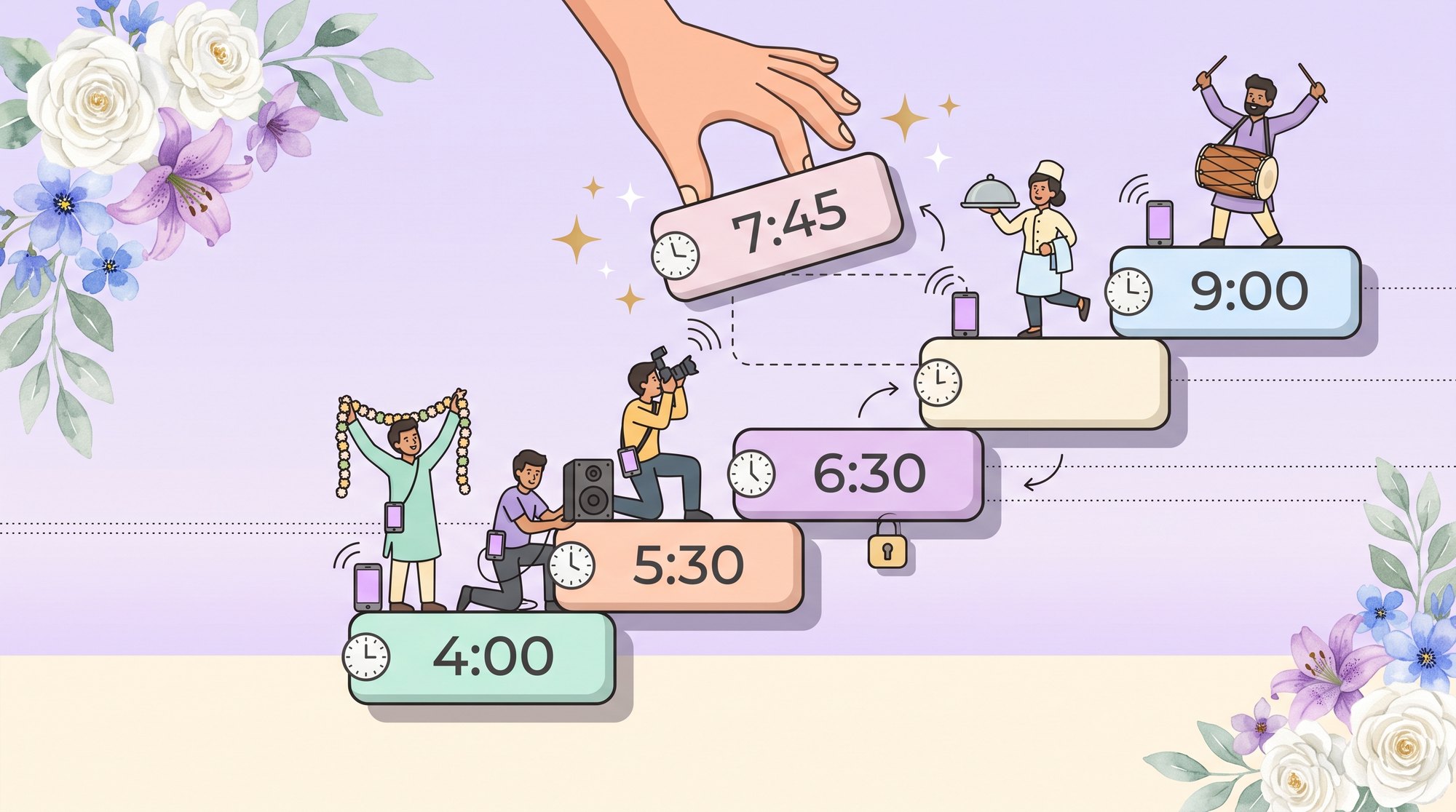
- Build the day-of run-of-show and a contact sheet with one number per vendor.
- Decide how guests will check in and find their way between events.
The days themselves
By the time the Haldi turmeric comes out, your job is to be present — not to coordinate. Hand the timeline to your family and vendors, delegate a point person for each function, and let the plan carry the day. That’s the entire reason you built it.
An Indian wedding timeline doesn’t count down from twelve months. It counts forward from the date the pandit gives you.
So forget the rigid monthly checklist. Anchor everything to your muhurat, grab the high-demand vendors the moment the date is set, give each function its own plan, and keep one source of truth everyone can see. Do that, and even a three-month runway feels calm — while an eighteen-month one feels effortless.