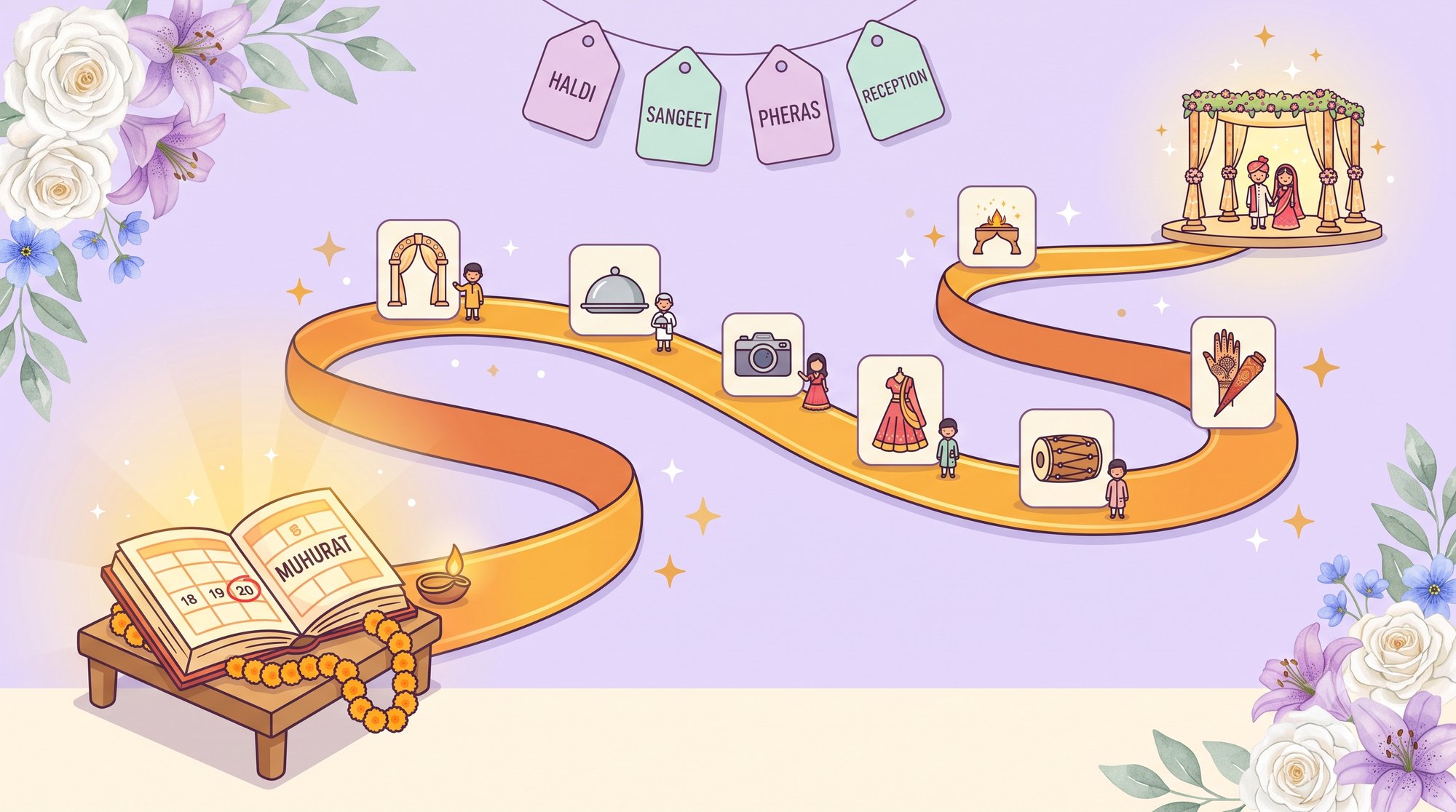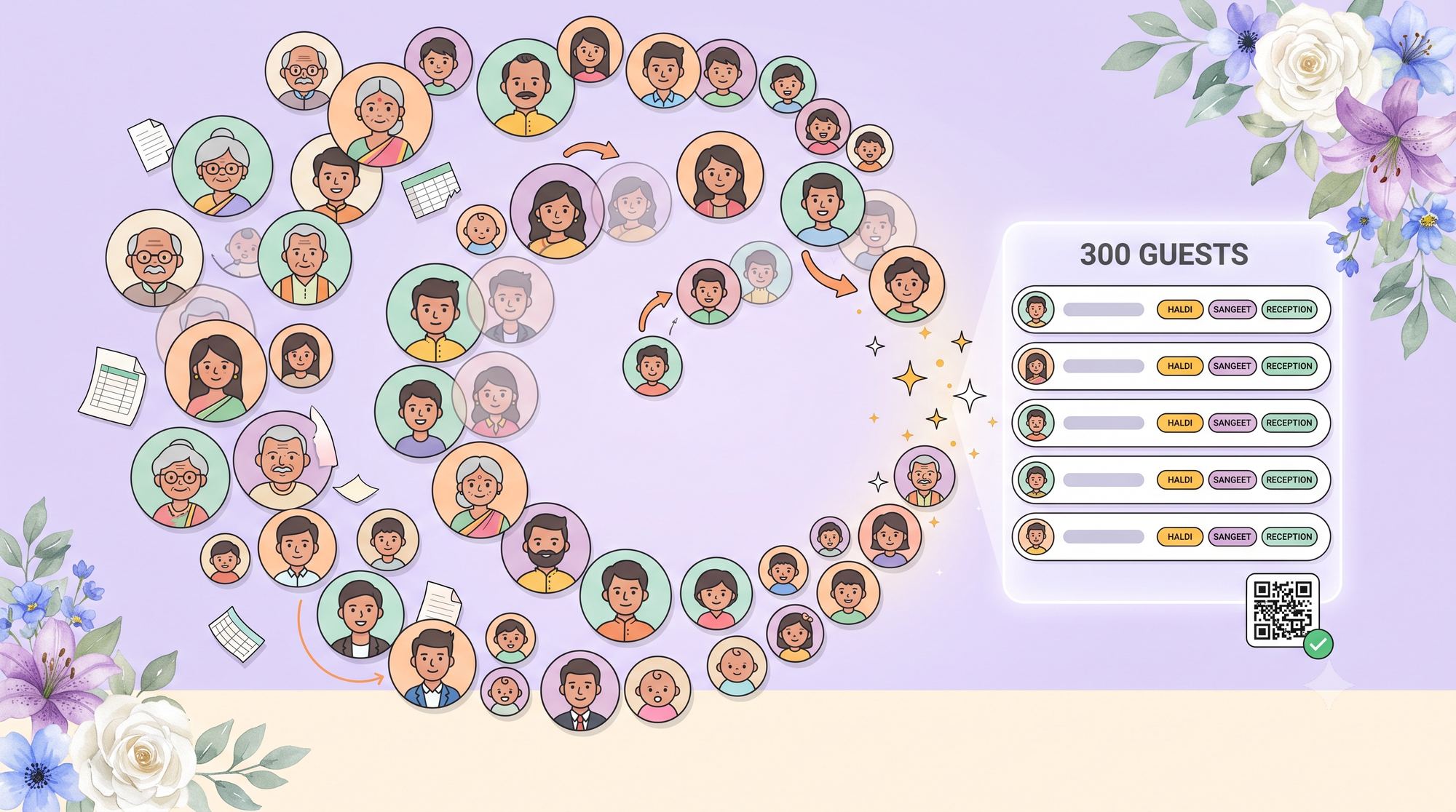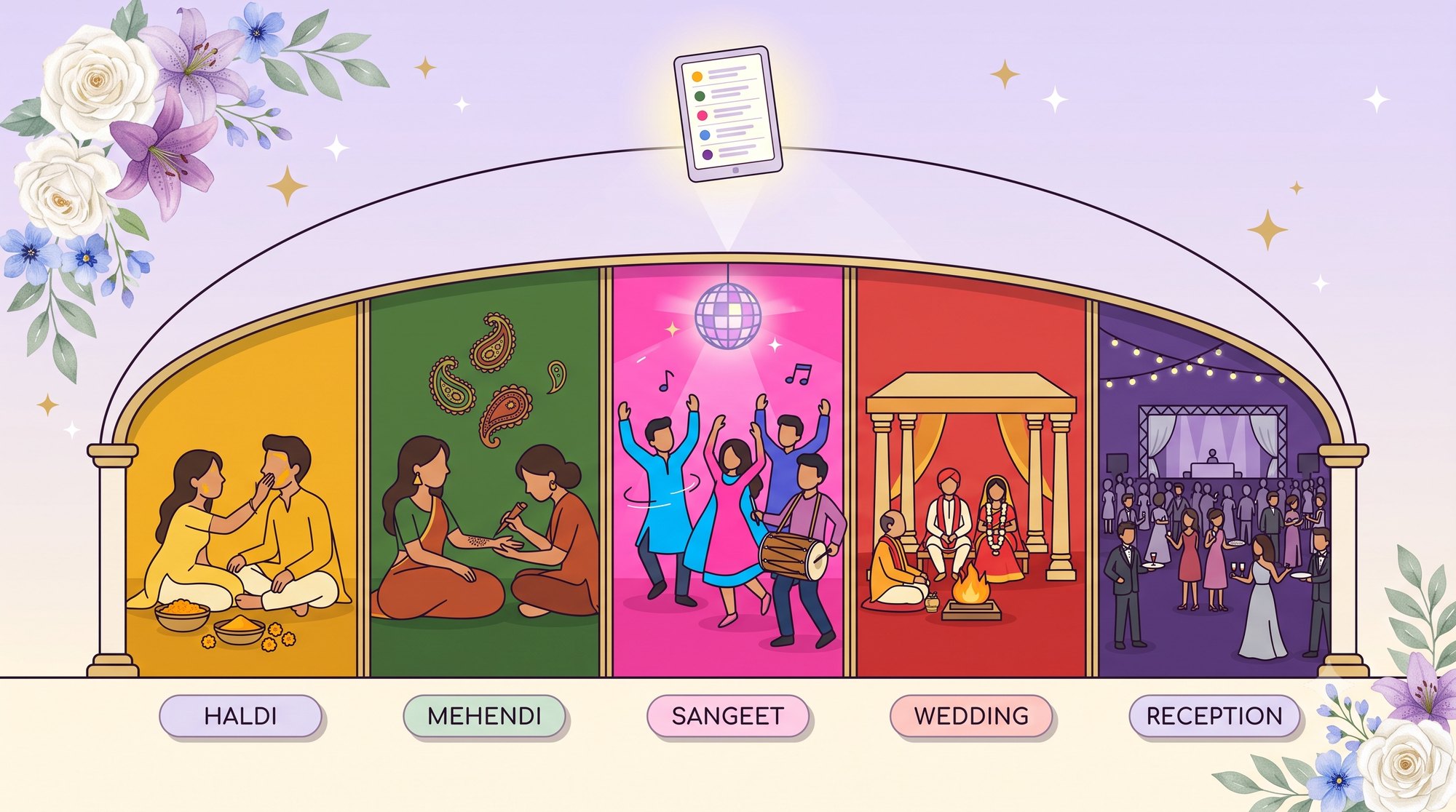
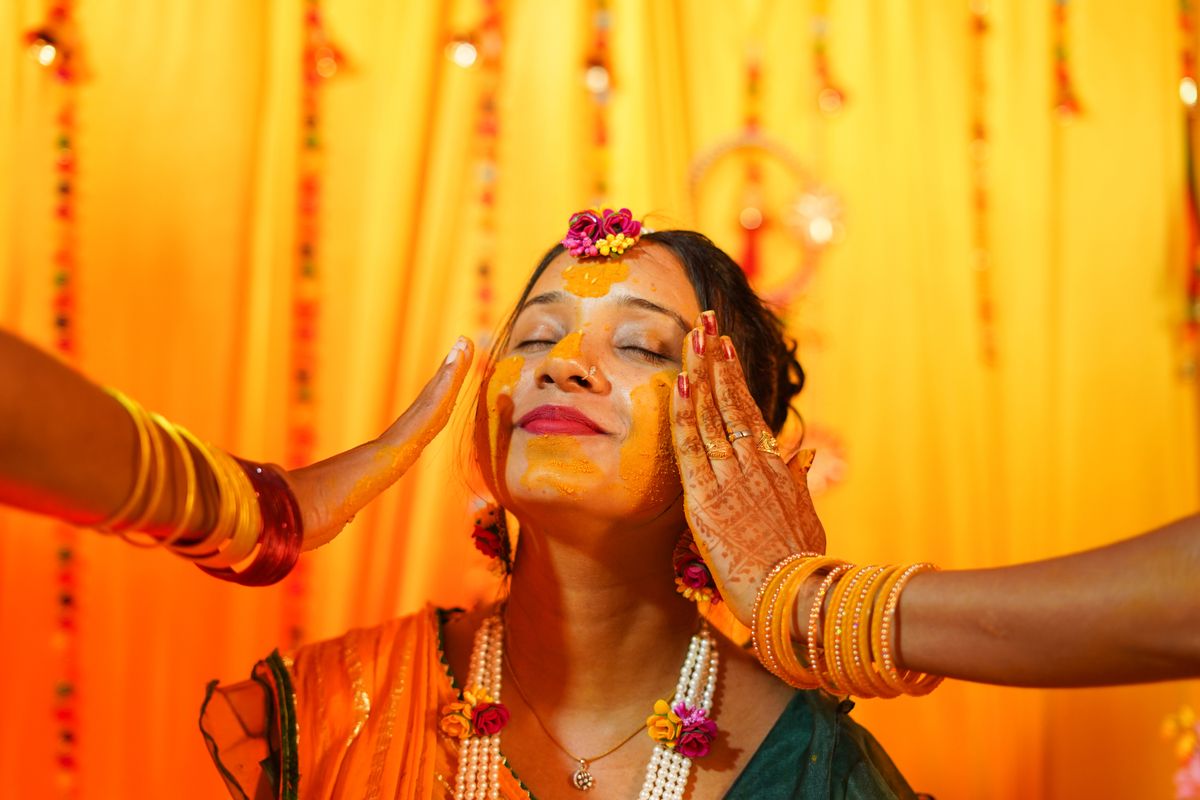
A modern Indian wedding is really a festival — a string of celebrations, each with its own colors, customs, and crowd. The Haldi is intimate and family-only; the Sangeet is loud and joyful; the reception might be five hundred strong. Planning it well means treating each event as its own thing while keeping the whole festival in one view. Here’s how.
Why multi-event weddings are uniquely tricky
It’s not just “more events.” It’s that each one has different everything:
- Different guests. Close family at the Haldi, the whole world at the reception.
- Different venues and timings, sometimes on the same day.
- Different vendors — the Sangeet’s DJ isn’t the wedding’s priest.
- Different vibes, which means different decor, menus, and dress codes.
Try to run all of that from one flat guest list and one timeline, and the events blur together. The Haldi-only guests get reception details they don’t need; the caterer gets the wrong count for the wrong night.
The principle: one wedding, many events
The fix is structural. Think of your wedding as a single project made of distinct events (some call them stages or functions). Each event holds its own:
- Guest list and attendance
- Date, time, and venue
- Run-of-show and rituals
- Menu, decor notes, and vendors
Zoom out and you see the whole festival; zoom into any one event and you get just that celebration’s details. That separation is what keeps a five-event wedding from turning into noise.
Four habits that keep it organized
1. Tag every guest by event
Instead of one master list, mark who’s invited to what. Then each function has an accurate count, and communications go only to the people they concern.
2. Give each event its own timeline
The Haldi’s run-of-show has nothing to do with the reception’s. Keeping them separate means each one is clear — and vendors see only the function they’re working.
3. Make day-of navigation effortless
When guests arrive, they should instantly see their events — not a wall of functions they weren’t invited to. A guest checking in for the wedding shouldn’t be handed the after-party schedule.
4. Keep it all under one roof
The events are separate, but they belong to one wedding. You want a single place to manage them — not five disconnected spreadsheets and five group chats.
Every function, organized — in one place
eventsplanning.ai models your wedding as separate events, each with its own guest list, timeline, menu, and check-in — while keeping the whole celebration in a single shared workspace. Guests see only the events they’re invited to.
Plan Your Events FreeGive each celebration its own moment, and the whole festival feels intentional instead of overwhelming.
Haldi, Mehendi, Sangeet, wedding, reception — each one earns its own attention. Treat them as distinct events under one wedding, tag your guests, and let each function carry only its own details. Do that, and a sprawling, five-part celebration becomes something you can hold in one hand — and actually enjoy.