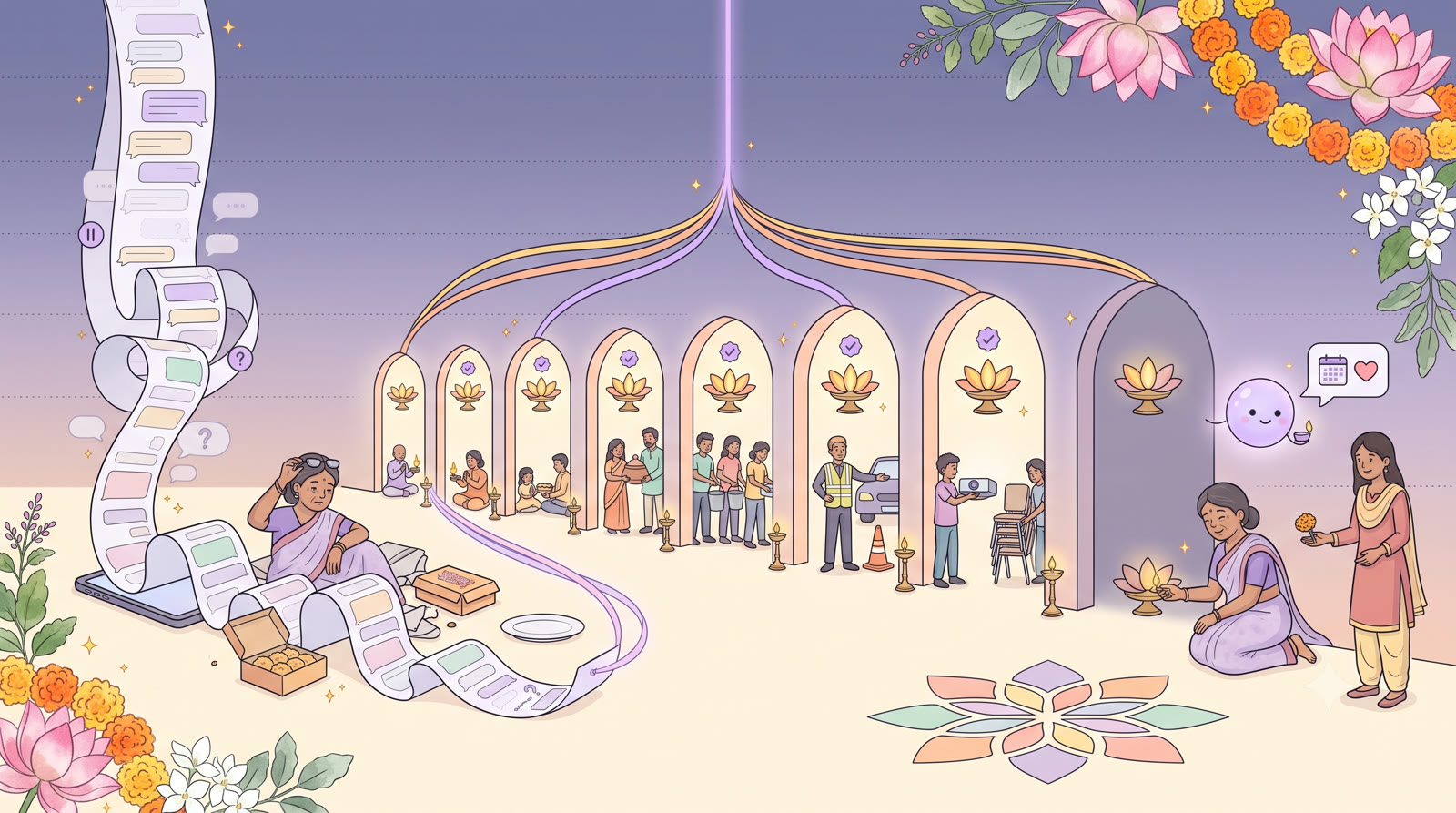
A katha is not one evening repeated nine times. Each evening has a yajman, prasad for however many turn up, a hall that has to be set before anyone arrives and cleared after everyone leaves, and parking that becomes a problem at exactly 6:40pm. Multiply by nine. Now run it from a WhatsApp group.
The group-chat problem
Everybody knows this one. Someone writes “I can do Tuesday” at eleven in the morning, and by evening it is forty messages back. On Friday nobody can say whether Tuesday is covered, so the organiser asks again, and three people answer who already answered.
The failure is not that people are unwilling — a katha is usually over-supplied with willing hands. It is that a chat has no idea how many a job needs, and no memory. So two families bring prasad on the same day, and nobody brings it on the next.
What a seva list actually needs
Four things, and a chat gives you none of them:
- A number. Serving help on a Saturday needs six people, not “some”.
- A day attached. Most seva is day-specific. “Parking” is nine different jobs.
- Visibility. People will take the empty day if they can see which one it is.
- A close. When Day 3 yajman is taken, it should stop being offered.
Three sheets, not one
In practice a mahotsav splits cleanly into three lists, and keeping them apart matters because they fill at different speeds.
Yajman seva goes day by day — usually two per day — and tends to fill first, often within hours of the link going out. Food seva needs two different things for each evening: one family bringing prasad, and six or so hands to serve it. Volunteers is everything that makes the evening possible — parking and traffic, the registration and welcome desk, hall setup with chairs and stage before the first day, sound and projector, and cleanup after each evening.
Keep them as three lists and each reads in a glance. Merge them into one and the yajman days get buried under thirty rows of logistics.

One link, posted once
The whole point is that the organiser stops being the database. A single link goes in the group. Somebody takes Day 4 prasad seva and it disappears for everyone else. Somebody takes the last serving slot on Day 2 and that row closes itself. Nobody replies-all, and nobody has to be asked twice.
The organiser’s job shrinks to the part that actually needs a person: looking at what is still empty three days out, and calling the two families who always say yes.
Yajman, prasad and parking — on one link.
Three seva sheets with a number against every job and a day attached to each. Post the link once; it counts, it closes when full, and it remembers who said yes.
Set Up Seva Sign-Ups FreeThe evenings themselves
Each evening is its own item on the timeline, which gives you two useful things. Attendees can see which evening is on and what time it starts, without asking. And the sign-ups attached to a day tell the kitchen something real — if Day 6 has twice the serving volunteers of Day 2, that is usually because Day 6 is the big one, and the prasad should be cooked accordingly.
A note on asking
Seva is offered, not assigned. The wording matters more here than at any other kind of event: a list that reads like a rota gets a different response from one that reads like an invitation. “Please pick where you can help — every hand counts” costs nothing and changes the reply rate.
A katha is rarely short of willing hands. It is short of a list that remembers them.
Three sheets, a number against every job, a day attached to each, one link in the group. That is most of the organising, and it takes about twenty minutes to set up.