Ask what a college fest is and you get one name. Ask what it actually involves and you get forty answers: a hackathon that runs overnight, a culturals night with twelve acts, six workshops, a sports bracket, a speaker series, and a registration desk that opens at seven in the morning three days running. The name is singular. Almost nothing else about it is.
A fest is several events wearing one name
This is the thing that makes a fest different from every other event of its size. A conference has one agenda. A wedding has one guest list. A fest has a hackathon with its own rules, prize money and judges; a culturals night with a line-up and rehearsals; and a workshop track where each session takes its own registrations and caps at thirty.
Teams usually solve this one of two ways, and both hurt. Treat the fest as a single event and you end up with one spreadsheet that nobody can read by week three. Treat each activity as a separate event and no one can see the weekend as a whole — which room is double-booked, which coordinator is running two things at once.
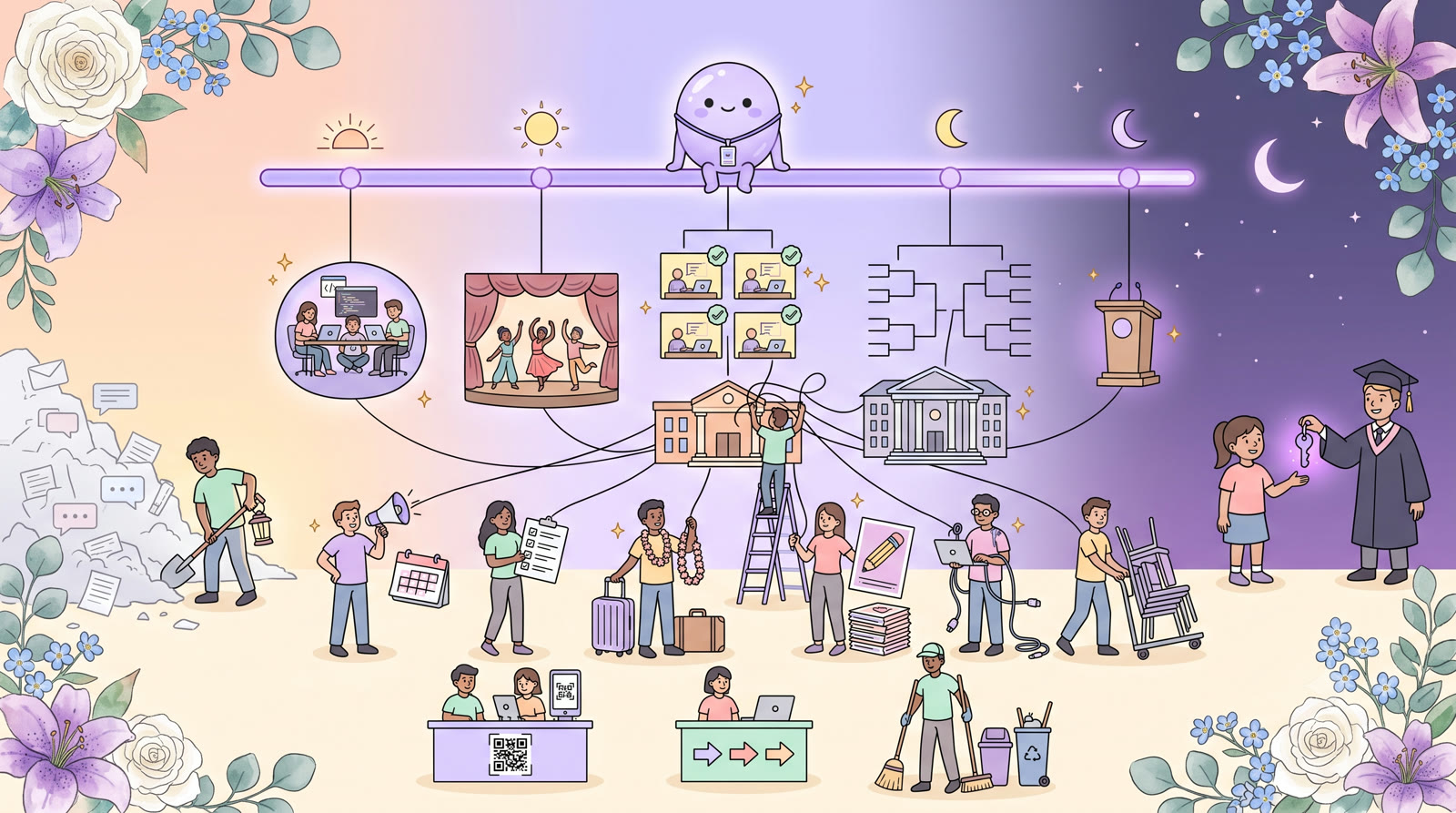
The useful shape is in between: one event, many activities, each with its own page, its own schedule and its own registrations, all hanging off one timeline you can look at in a single screen.
The committees are the actual project
Long before the fest, there is the work of building it. In practice that falls into about six groups, and the numbers matter as much as the names:
- Publicity & social media — four people, because it is a daily job for a month.
- Sponsorship outreach — three, each with their own list so nobody calls the same firm twice.
- Hospitality — speakers, judges and visiting teams. Four, and they need phone numbers at midnight.
- Design — posters, badges and certificates. Two, and they are the bottleneck in the final week.
- Tech — website, registrations and AV. Three.
- Logistics — rooms, equipment and food. Four, and this is where the fest is actually won or lost.
Then there is the day itself: a registration desk that needs five people in the morning and three in the afternoon, an activity coordinator for every competition and session, stage and sound, a help desk for people who cannot find Room 204, and a clean-up crew nobody volunteers for until you ask by name.
Let the sheet do the counting
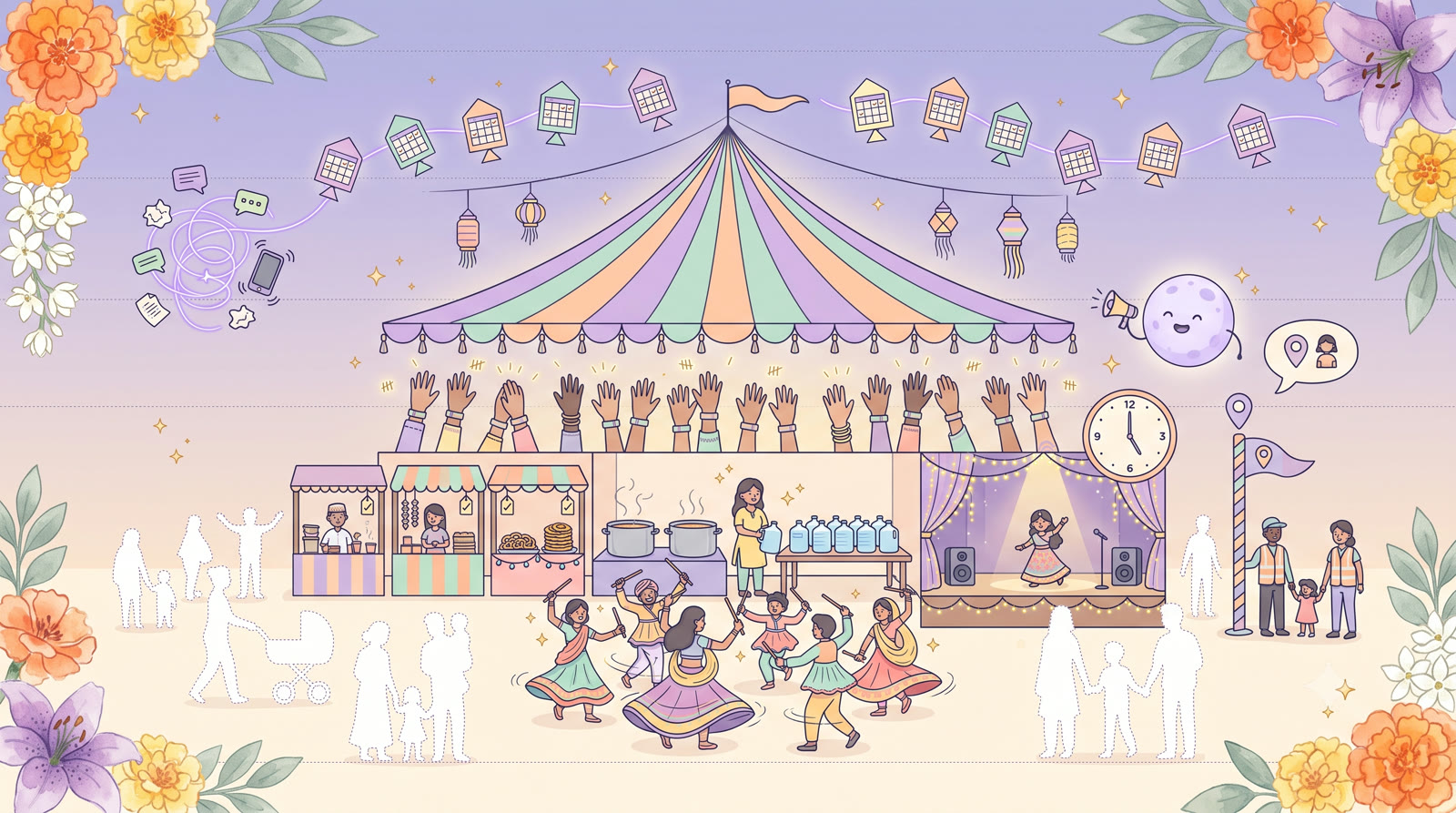
Most fests run all of this through a group chat and a form. The form does not know that the morning desk needs five people and the afternoon needs three, so you get eleven for one and none for the other. The group chat does not remember who said yes — “I can do Saturday” scrolls out of view in an hour.
A sign-up sheet knows the number. Every job carries how many people it needs; the link shows what is still open; a role closes itself when it fills. You post one link, and the counting stops being somebody’s job.

Registrations, per activity
A participant coming for the hackathon does not need the dance competition rules, and the workshop with thirty seats needs to stop at thirty by itself. Giving each activity its own page — schedule, rules, team size, a register button — means the information a participant gets is the information that applies to them, and the cap enforces itself.
It also gives each coordinator something to point at. “Send them the link” is a better answer than a PDF forwarded eleven times.
Every committee, every activity, one weekend.
Sign-up sheets that know how many people each job needs, a page per activity with its own registrations, and a timeline the whole core team can see. Free for student teams.
Plan Your Fest FreeOn the day
Three days, several venues, and a volunteer roster that changes every few hours. Two things carry most of the weight here: a QR code at the desk so arrivals do not queue behind one laptop, and a shared view of what is running right now, so the help desk can answer without calling anyone.
The handover nobody plans for
Here is what makes a fest genuinely harder than a wedding: the people who know how it works graduate. Every year a new core team inherits a WhatsApp group they were never in, a Drive folder with four versions of the sponsorship deck, and a vendor they can only reach through a senior who left.
If the fest lives in one place — committees, contacts, vendors, budget, run of show, who did what and when — the handover is a login rather than an excavation. That is worth more over three years than anything you do in the week before the fest.
A fest is not harder than a wedding. It is forty weddings that all want the same auditorium.
Start with the committees and the numbers they need. Give each activity its own page. Put the whole weekend on one timeline. Everything else — the sponsors, the certificates, the clean-up — hangs off those three.